

Written by Toby Dankbaar, Laundrlab co-owner · Updated 2 October 2026
Introduction
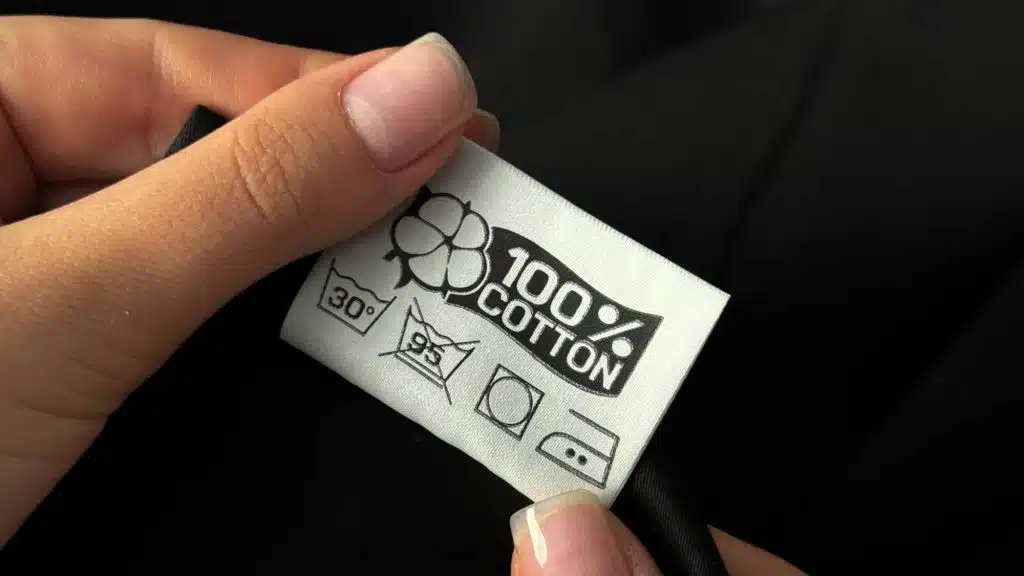
Ever stared at a care label wondering if your new shirt is machine-washable or destined for dry cleaning only? You’re not alone.
Laundry symbols might look like cryptic hieroglyphics, but once you understand what they mean, they become your secret weapon to keeping clothes looking fresh, fitted, and fabulous.
In this series, we’ll break down every laundry symbol into simple sections, complete with helpful icons, so you can wash with confidence and avoid laundry disasters.
- Every Washing Symbol Explained
- Every Drying Symbol Explained
- Every Ironing Symbol Explained
- Every Dry/Wet Cleaning Symbol Explained
- Every Bleaching Symbol Explained
Did you know your iPhone has the ability to be a laundry symbol decoder?
Australia’s mandatory care-labelling standard allows clothing and textile care instructions to be provided in English, through five internationally recognised symbol groups, or by using both. The Australian Competition and Consumer Commission provides an official guide to clothing care labels.
How to read the extra marks on laundry symbols
The shape identifies the type of care. The marks inside or beneath it tell you the limits.
- A cross means do not: A crossed-out symbol prohibits that treatment.
- Dots show heat: More dots generally mean a higher permitted temperature.
- A number is a maximum: A number inside the washtub is the highest permitted wash temperature in degrees Celsius.
- One line underneath means mild: Use reduced mechanical action, often labelled permanent press or a similar gentle setting.
- Two lines underneath mean very mild: Use a delicate or very gentle process.
- Diagonal lines usually mean shade: On natural-drying symbols, diagonal lines in the corner mean dry away from direct sunlight.
Always read the complete care label. Written warnings such as “wash separately”, “reshape while damp” or “do not soak” can add important instructions that are not captured by a single icon.
Washing Symbols
A washtub symbol explains whether the item can be washed in water, the maximum temperature and how gentle the wash action should be.

Washing

Machine Wash Permanent Press

Machine Wash Gentle Cycle

Do Not Wash

Hand Wash

Do not wring

Wring

Wash at or below 30°c

Wash at or below 40°c

Wash at or below 50°c

Wash at or below 60°c
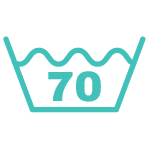
Wash at or below 70°c
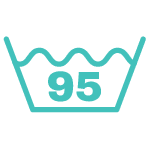
Wash at or below 95°c

Wash at or below 30°c

Wash at or below 40°c

Wash at or below 50°c

Wash at or below 60°c

Wash at or below 70°c

Wash at or below 95°c
Machine wash
A plain washtub means the item can be machine washed using a normal process. Check for a number or dots inside the tub before selecting the temperature.
Mild or permanent-press wash
A washtub with one line underneath calls for a milder process with reduced agitation. On some machines this may be labelled permanent press, easy care or synthetics.
Delicate or very gentle wash
Two lines underneath the washtub mean the item needs a very mild process. Use a delicate or gentle cycle and avoid overloading the machine.
Hand wash
A hand inside the washtub means hand wash. Under the Australian guide, this represents hand washing at a maximum of 40°C. Handle the item gently and avoid twisting it unless the label specifically permits wringing.
Do not wash
A crossed-out washtub means the item must not be washed in water. Check the rest of the label for professional-cleaning instructions.
Wring and do not wring
A twisted-fabric symbol indicates wringing. A cross through it means do not wring, as twisting may stretch, crease or damage the fibres. Press water out gently or follow the drying instructions instead.
What do the wash-temperature symbols mean?
The number inside the washtub is the maximum wash temperature, not a requirement to use that temperature every time.
| Label | Meaning |
|---|---|
| 30°C | Wash at or below 30°C |
| 40°C | Wash at or below 40°C |
| 50°C | Wash at or below 50°C |
| 60°C | Wash at or below 60°C |
| 70°C | Wash at or below 70°C |
| 95°C | Wash at or below 95°C |
Some labels use dots instead of numbers. In the most commonly encountered system, one dot indicates a cool wash, two dots a warmer wash and three dots a hot wash. Because labelling systems can vary, follow any written temperature instruction on the garment when one is provided.
A cooler setting may be suitable when the care label allows it, but stain type and hygiene needs also matter. Read our guides to cold-water washing and when to use hot water for laundry before choosing a temperature for a specialised load.
Drying Symbols
A square describes drying. A square containing a circle refers specifically to tumble drying; lines inside a square describe natural drying.
This distinction matters: do not tumble dry does not automatically mean do not dry. It may mean the item should be line dried, drip dried or dried flat instead.

Tumble dry – Normal

Tumble dry – Low heat

Tumble dry – Medium heat

Tumble dry – High heat

Tumble dry – No heat

Tumble dry gentle

Tumble dry very gentle

Do not tumble dry

Natural dry

Do not dry

Line dry

Dry flat

Drip dry

Shade dry

Line dry in shade

Dry flat in shade

Drip dry in shade
Tumble-drying symbols
Tumble dry
A square containing a circle means the item can be tumble dried. The dots inside the circle indicate the permitted heat.
Tumble dry on low heat
One dot means tumble dry at a low temperature. The Australian consumer guide defines this as a maximum exhaust temperature of 60°C.
Tumble dry at normal temperature
Two dots mean tumble drying is permitted at a normal temperature, with a maximum exhaust temperature of 80°C under the Australian guide.
Some garments, particularly those using other labelling systems, may also show three dots for high heat or a filled circle for no heat or air drying. Treat the marks as maximum settings and follow any accompanying words.
Gentle tumble dry
One line beneath the tumble-dry symbol means use a mild process. Two lines mean use a very gentle process.
Do not tumble dry
A cross through the square-and-circle symbol means the item must not go in a tumble dryer. Look for the natural-drying symbol elsewhere on the label.
Natural-drying symbols
Line dry
A square with a vertical line means hang the item to dry on a line.
Drip line dry
Multiple vertical lines mean hang the item while wet and allow it to drip dry. Avoid wringing it first.
Dry flat
A horizontal line inside the square means lay the item flat to dry. This helps garments such as knitwear retain their shape.
Drip dry flat
Multiple horizontal lines mean lay the item flat while still wet and allow it to drip dry.
Dry in the shade
Diagonal lines in the corner of a natural-drying symbol mean keep the item out of direct sunlight. They may be combined with the line-dry, drip-dry or flat-dry instruction.
Do not dry
A crossed-out square means do not use the represented drying process. This is different from the more specific crossed-out tumble-dryer symbol, so check the entire label and any written instructions.
If the item is tumble-dryer safe, choose the lowest setting that meets the label and your needs. Laundrlab’s washer and dryer guide lists the available dryer sizes and temperature settings.
Ironing Symbols
An iron icon tells you whether the garment can be ironed and the highest suitable soleplate temperature.

Iron

Do not iron

Iron at low temperature

Iron at medium temperature

Iron at high temperature

Steam

Natural dry
Use the lowest effective temperature, particularly on synthetic, printed or embellished fabrics. A “do not steam” instruction means dry ironing may still be allowed if the main iron symbol permits it.
| Iron symbol | Meaning |
|---|---|
| One dot | Iron at a low temperature, maximum 110°C |
| Two dots | Iron at a moderate temperature, maximum 150°C |
| Three dots | Iron at a high temperature, maximum 200°C |
| Crossed-out iron | Do not iron |
| Cross through steam lines | Do not steam |
Professional dry-cleaning and wet-cleaning symbols
Some of your clothing requires dry or wet cleaning. Here’s what those dry cleaning symbols on your clothing tags mean:

Dry Clean

Do not dry clean

Dry clean short cycle

Dry clean reduced moisture

Dry clean no steam

Wet clean

Do not wet clean

Gentle wet clean

Very gentle wet clean

Dry clean any solvent

Dry clean, hydrocarbon solvent only

Gentle dry clean, hydrocarbon solvent only

Very gentle dry clean, hydrocarbon solvent only

Dry clean with PCE

Gentle dry clean with PCE

Very gentle dry clean with PCE
Dry clean
A plain circle indicates professional cleaning. Letters inside the circle tell the cleaner which solvent system can be used:
- P: Professional dry cleaning using perchloroethylene and permitted hydrocarbons.
- F: Professional dry cleaning using hydrocarbons.
One line beneath the circle means a mild professional process. Two lines mean a very mild process. Extra markings may instruct the cleaner to limit moisture, mechanical action, heat or cycle duration.
Do not dry clean
A crossed-out circle means the garment must not be dry cleaned.
Professional wet clean
A W inside a circle indicates professional wet cleaning. One line beneath it means a mild process; two lines mean a very mild process. A crossed-out W circle means do not professionally wet clean.
Professional wet cleaning uses specialist equipment, chemistry and finishing. It is not the same as placing the garment in an ordinary water-based wash.
If a valuable garment carries professional-cleaning symbols, show the complete care label to the cleaner rather than trying to interpret solvent codes as home-treatment instructions.
Bleaching Symbols
The triangle tells you whether a bleaching product may be used.

Bleach

Do not bleach

Do not bleach

Chlorine bleach

Non-chlorine bleach

Non-chlorine bleach
Any bleach allowed
An empty triangle means a bleaching agent may be used when needed. You must still follow the bleach product’s instructions and confirm that it is appropriate for the fabric and colour.
Only non-chlorine bleach allowed
A triangle containing two diagonal lines means only oxygen-based or non-chlorine bleach is permitted. Do not substitute chlorine bleach.
Do not bleach
A crossed-out triangle means bleaching is not allowed. This applies to both chlorine and oxygen-based bleaching products.
You may encounter older or alternate-looking bleach icons on imported or older garments. If the symbol is unclear, follow the written care instructions or contact the garment manufacturer rather than guessing.
Never mix bleach with vinegar, ammonia, acids or other household cleaners.

What if the care label is missing or unreadable?
Do not assume the most convenient cycle is safe.
- Check the retailer or manufacturer’s product page.
- Identify the fibre content and construction, including linings, prints and embellishments.
- Use a conservative cold or gentle treatment only if the item is clearly washable.
- Seek professional advice for wool, silk, leather, suede, structured garments or valuable items.
Fibre content alone does not tell the whole story. Dyes, trims, adhesives and garment construction can all change the correct treatment.
Can an iPhone identify laundry symbols?
Supported iPhones can recognise care-label symbols from a clear photo and display laundry-care information in the Photos app. This is useful when a symbol is difficult to identify, but the garment’s written instructions remain the authority.
See our step-by-step guide to reading laundry symbols with an iPhone.
Using care labels at Laundrlab
Laundrlab is a self-service laundromat, so customers choose and load their own washing and drying cycles.
Before placing an item in a machine:
- Confirm that it is machine washable.
- Check its maximum wash temperature.
- Look for mild or delicate-cycle instructions.
- Confirm that tumble drying is allowed before using a dryer.
- Separate incompatible colours and fabrics.
- Pre-treat stains using a product that is safe for the garment.
- Do not place dry-clean-only or professional-wet-clean-only items in a standard washer.
Our commercial machines provide room for suitable everyday laundry and bulky washable items, but they do not override the manufacturer’s care instructions. If you are unsure, pause and check the label before starting the cycle.
You can also read our clothing stain-removal guide, learn how to make clothes last longer or find your nearest Laundrlab.
The simplest way to remember laundry symbols
Start with the shape:
- Washtub = wash
- Triangle = bleach
- Square = dry
- Iron = iron
- Circle = professional care
Then read the modifiers: a cross means do not, dots indicate heat, numbers set a maximum temperature and lines underneath call for a gentler process.
The care label is there to protect the garment. Taking a few seconds to read it can prevent shrinking, fading, colour transfer and avoidable fibre damage.
Frequently asked questions
The five main shapes are a washtub for washing, a triangle for bleaching, a square for drying, an iron for ironing and a circle for professional textile cleaning.
A cross means that treatment must not be used. For example, a crossed-out washtub means do not wash, while a crossed-out square containing a circle means do not tumble dry.
Dots indicate heat. More dots generally permit a higher temperature. On an iron, one, two and three dots mean maximum temperatures of 110°C, 150°C and 200°C respectively.
One line means the item needs a mild process, often called permanent press or easy care. Two lines mean a very mild or delicate process with reduced mechanical action.
It is the maximum permitted wash temperature. A cooler wash may be suitable, but the stain, hygiene requirements and detergent performance should also be considered.
Do not tumble dry prohibits using a tumble dryer. The item may still be suitable for line drying or flat drying if the label shows that instruction. Do not dry is a broader prohibition that must be read with the complete care label.
A circle gives instructions to a professional textile cleaner. Letters such as P and F identify permitted dry-cleaning solvent systems, while W indicates professional wet cleaning.
Only if the manufacturer’s instructions or machine documentation confirm that a suitable hand-wash program is safe. A standard machine cycle may use too much agitation, spin speed or heat.
Laundrlab is a self-service laundromat, not a dry cleaner. Do not put a dry-clean-only or professional-wet-clean-only garment into a standard washing machine.
Disclaimer: The advice provided in this article is meant for general informational purposes only. Always refer to the care instructions provided by the manufacturer for your specific laundry machines and clothing/bedding items.
Related articles

What to do if you see liquid-detection alert on your iPhone (2026)
Dropped your iPhone in water, or worse, the washing machine? Modern iPhones are water-resistant, but what you do next can make or break it. Here’s what Apple...
read more
7 Laundry Myths Debunked
Discover common laundry myths about hot water, detergent, fabric softener, bleach and more, so you can wash clothes properly.
read moreExternal sources
- ACCC Product Safety: Care labelling on clothing and textiles
- ACCC Product Safety: Mandatory care-labelling standard
- CHOICE: Clothes washing symbols explained
- Drycleaning Institute of Australia: Care Labelling Guide
